with a menu of photography, books, jazz, poetry, and other items occasionally

Thursday, February 07, 2019

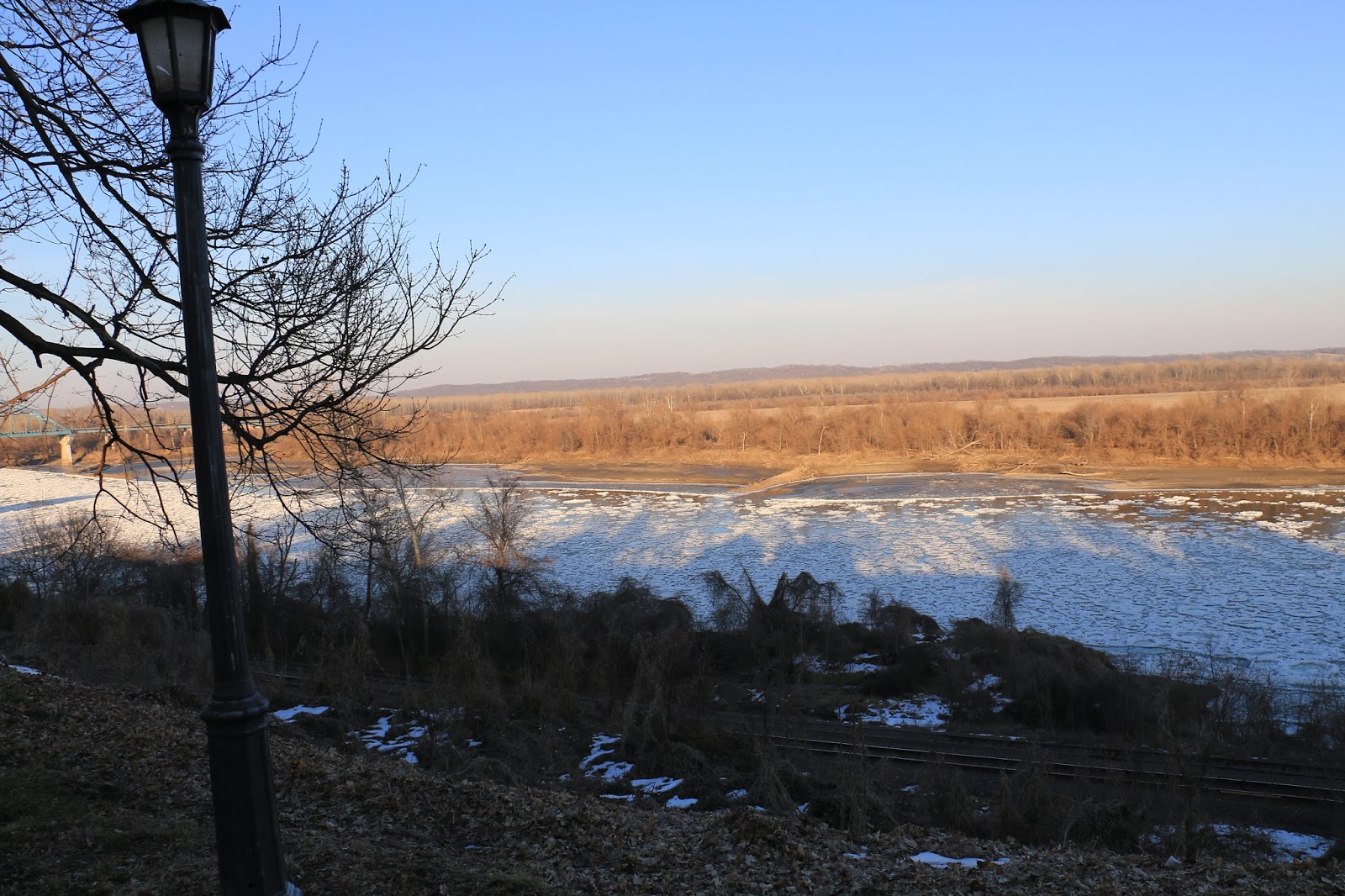
Ice on the Missouri River

Last week, during a lull in my online teaching and after the weather began to warm up a little, I went walking with my camera and got some pictures of the Missouri River. The ice was more prominent at first. Over the course of three days, the ice nearly disappeared. More ice will be forming soon, despite the prediction of the ground hog in Pennsylvania, more than a thousand miles to the east.


Monday, January 07, 2019

Reading in 2018


Like the years 2016 and 2017, in which I read 22 books each year, I read 22 books during 2018 as well. As I mentioned once before, I don’t include those books of poetry that I read during the year because I don’t know when I can say that I have fully read a book of poems. The great majority of my reading during the year focused on nonfiction, with the exception of three novels by Ivan Doig that I read early in the year.

 In addition to reading Ivan Doig’s Bartender’s Tale and Last Bus to Wisdom, both of which were readily available at the local Barnes & Noble, and both of which make up his best novels, I read his Ride with Me, Mariah Montana, which my son ordered for me from one of the merchants at Amazon. I have since ordered secondhand copies of four other books by Ivan Doig and plan on reading them during the current year. These new additions to my library help to bring the total number of books listed at LibraryThing to 971, which is 29 more than the number of books listed during January, 2017.

As I mentioned in 2017, the historian Elliot West in his collection of essays introduced me to some of the western writers that I had overlooked, namely, Ivan Doig and Mary Clearman Blew. My reading Blew’s Bone Deep in Landscape has also introduced me to novels that I have neglected by A.B. Guthrie, Jr., and Mildred Walker, something which I plan on correcting soon. Blew manages to mix memoir with literary criticism and vivid descriptions of place, particularly Montana and Idaho, in not only Bone Deep in Landscape but also in This Is Not the Ivy League and Balsamroot. Blew in Bone Deep in Landscape recognizes that the “western landscape is permeated with private associations contained in memory and family narrative.”

Linda Hasselstrom records her daily observations and her memories in Gathering from the Grassland, a book that details the passing of a year. Hasselstrom places a great deal of attention on the lives of her father and mother, whose correspondence and journals she describes and analyzes. Tara Westover describes her own family life in Educated, a book that has gained a lot of attention. It surprised me how often the writer felt compelled to return home even when she was living overseas. She was lucky to have the money to fly from London to Idaho during Christmas break, for example. The issue of how the writer supported herself overseas is not addressed in the book.

The remainder of my reading for the year falls into three categories—history relating to the Native people in this country, more recent history, and the natural world. Finding a number of references to the Nez Perce in Blew’s memoirs and not terribly familiar with the Native people of the Northwest, I read Daniel J. Sharfstein’s Thunder in the Mountains: Chief Joseph, Oliver Otis Howard, and the Nez Perce War. Previously, I was aware that Chief Joseph and about 400 members of his band were imprisoned at Fort Leavenworth in or near the area that now contains the airport. Many places in Kansas once contained the voices of the Native people.

My reading of Vernon R. Maddux and Albert Glenn Maddux’s In Dull Knife’s Wake: The True Story of the Northern Cheyenne Exodus of 1878 makes me want to return to western Kansas to see the remnants of the Battle of Punished Woman's Fork. I had overlooked that area when I was visiting Scott County Lake and Monument Rocks about ten years ago. Some of my other reading, that is, Give me Eighty Men, Where One Hundred Soldiers Were Killed and The Wagon Box Fight, related to the trip that my wife and made to Wyoming in 2016.

I was surprised to see the emphasis on Christianity when I was reading Indianapolis and Killers of the Flower Moon. Many people learned of the USS Indianapolis in the Steven Spielberg movie Jaws, when the character Quint describes his eyewitness account of the sailors eaten by sharks during the four days that the crew of the USS Indianapolis awaited rescue after their ship was torpedoed by a Japanese submarine.  Lynn Vincent and Sara Vladic in Indianapolis: The True Story of the Worst Sea Disaster in U.S. Naval History and the Fifty-Year Fight to Exonerate an Innocent Man provide a history of the ship. Vincent turns over the narrative to Vladic, once the ship has been torpedoed, and Vladic’s religious faith becomes strongly present as Vladic describes, in detail, the appeals that the sailors made to their God. These appeals could have easily been given less attention. Likewise, some of the coincidences that occurred while the sailors were in the water could have not been related to prayers; it’s the author who makes the connection between a fortuitous event and prayer. A similar emphasis on religious faith appears in Killers of the Flower Moon: The Osage Murders and the Birth of the FBI when David Grann, the author, quotes a poem that “echoed Jesus’s command in the Sermon on the Mount” when the block quote is totally unnecessary. The author provides another block quote taken from “Dies Irae,” what the author describes as a “rhythmic thirteenth-century hymn.” Neither quote is essential to the narrative. While I can understand that some people are more religious than I, I think that these authors interject too much of their religious faith in these books.  These writers shouldn’t assume that their intended audience shares their religious faith.

Out of the books related to nature that I read during 2018, I most enjoyed Quakeland and The Death and Life of the Great Lakes. My students often believe that essays derived from research should not include relevant references to the author because of things that they learned from their high school teachers. Both Dan Egan in The Death and Life of the Great Lakes and Kathryn Miles in Quakeland: On the Road to American’s Next Devastating Earthquake put themselves in their books, with Miles revealing what led to her interest and what discoveries that she made during her research, and with Egan revealing his observations, his experiences, and his interactions with the people interviewed for the book. Both books are excellently written, informative, and well-researched.

Although I plan on reading and possibly obtaining either new or used copies of Maxine Gordon’s Sophisticated Giant: The Life and Legacy of Dexter Gordon and Leonardo Trasande’s Sicker, Fatter, Poorer during the current year, and although I see myself discovering one or two novels by D’Arcy McNickle, I expect to buy fewer books during 2019 and to content myself with what I have left unread on my book shelves. I may eventually return to some of the books that I read when I was younger, such as Herman Hesse’s Steppenwolf or Siddhartha, Knut Hamsun’s Hunger, Pan, Victoria, or Growth of the Soil, or D. H. Lawrence’s Rainbow or Aaron’s Rod, to see whether they still have any appeal to me.


Monday, December 31, 2018

My Music Selections for 2018


Espen Eriksen Trio with Andy Sheppard. Perfectly Unhappy. Rune Grammofon. After having released three albums as a trio, this trio, composed of Espen Eriksen on piano, Lars Tormod Jenset on bass, and Andreas Bye on drums, is joined by Andy Sheppard, the British saxophonist, on their Perfectly Unhappy.  Andy Sheppard’s tenor saxophone accents the melody found in tracks like “1974,” “Perfectly Unhappy,” “Indian Summer,” and “Home.” The interplay between the saxophone and the trio is especially prominent on “Naked Trees.” I recommend this album and consider it as one of the best of the year.


Maciej Sadowski Kwadrat, ms2. One EP that came to my attention during 2018 is simply titled ms2. Created by the Maciej Sadowski Kwadrat, this album of nearly 21 minutes is meant to “foreshadow…[a] forthcoming full album.” All of the tracks on this EP are composed by Maciej Sadowski. The strong rhythm section, composed of Maciej Sadowski on double bass and Antoni Wojnar on drums, is most apparent on “Noz w lodzie” (translated, roughly, as knife in the ice) and “Kotojeleri Zlodziej” (translated, roughly, as cat thief). Michal Jan Ciesielski’s tenor saxophone is most notable on “Kotojeleri Zlodziej” and “Noz w lodzie.” The interplay between David Lipka’s trumpet and Ciesielski’s tenor saxophone is particularly strong on “Noz w lodzie.” Lipka’s trumpet solos on “Dziadek mroz part 1” (translated as Jack Frost) while both Ciesielski and Lipka solo on “Dziadek mroz part 2.” I like the driving rhythm and the saxophone solo in "Noz w lodzie," the bass intro to "Dziadek mroz Part 2," and the saxophone solo and the stopping and starting in "Kotojelen Zlodziej." Sadowski describes his music as nonjazz, that is, a commingling of “emotional improvisations…drawn… from many musical genres.” Jazz is such a fluid term that it allows the influence of music drawn from other cultures and other genres. There are, of course, certain preconceptions associated with jazz and labeling the music on this album as nonjazz is one way to appeal to a wider audience and a younger one. I look forward to hearing more of this nonjazz from Gdansk, Poland, when Maciej Sadowski releases the full-length album.


Justin Gray & Synthesis, New Horizons. I only discovered Justin Gray & Synthesis and their album New Horizons in February, 2018, four months after it had been released. This debut album features Justin Gray on the bass veena, an instrument that he invented and co-created. In addition to a strong quartet, Justin Gray is joined by a range of musicians, some of whom play the following instruments native to Pakistan and/or India-- that is, sarangi, mrdangam, sarode, bansuri, and esraj. This album, Justin Gray says, exhibits a “wide range of musical influences, including Indian classical, jazz, western classical, electronic and R&B music.” Some of the tracks on the album that deserve mentioning are “New Horizons,” “Reflections,” “Migration,” “Unity,” and “Serenity.” I particularly like the haunting string instrument solo in “Migration.” Let’s hope that Justin Gray & Synthesis continue to explore their influences.


Unfurl, Sleeping Giants. Another album which reflects a bridging of cultural traditions is Unfurl’s Sleeping Giants (in memory of Adam Warne). Adam Warne, who died in 2017 from bowel cancer, was a cofounder of the band and plays Egyptian percussion on this album, an EP that contains a little more than 31 minutes of music. The band, which hails from Manchester, also features Olivia Moore on violin, Gavin Barras on bass, Jim Faulkner on guitar, John Ball on santoor, and Maria Jardardottir on voice. John Ball’s santoor intro and solo on the track "Upstream" is noteworthy. Maria Jardardottir’s scatting on “Upstream” becomes more intense, starting at 3:50. While I cannot identify all of the instruments on “The Fox and the Wolf,” I particularly like Gavin Barras’ bass intro, the scatting of Maria Jardardottir, and Olivia Moore’ violin solo, which starts at 7:03. Olivia Moore’s violin is clearest on the tracks“Bear Stories” and "Sleeping Giants." Let’s hope that this band releases more music in the future. I imagine that Adam Warne would want the band to continue.


I am still listening to some of the other music released in 2018 and have not yet made any decisions about some of the other music listed to the right of this page.

Thursday, December 20, 2018

Figurative Use of Pictures in Canvas


As I mentioned in a previous post (https://redmooncafe.blogspot.com/2018/07/identifying-modules-in-canvas-with.html), I have been using my pictures to identify modules on the home page of my online classes. (My two sections are combined into one huge online class of fifty students.) For two semesters now, I have been using Canvas as the learning management system for my online classes. The layout of Canvas isn’t as easy to use as Angel, the previous learning management system that I used for a number of years.  Students easily get confused and don’t often take the initiative to explore all of what a class offers. One easy way to direct students in the right direction within the class is to use pictures that are linked to a module. Students still don’t always read what they should and blame me for the lack of clarity when there are plenty of opportunities to ask questions or to clear up confusion.

As I mentioned in my post containing pictures taken from my summer class (https://redmooncafe.blogspot.com/2018/07/identifying-modules-in-canvas-with.html), my pictures are often meant to be read figuratively. The picture identifying the personal essay module, for example, depicts someone about to travel across a bridge. That personal essay, as the first essay in the class, asks that the student achieve specificity in describing a person, an event, or an object and that the student pay attention to his/her language, with the aim of avoiding clichés and sentence-level errors, such as comma splices and fused sentences. The subsequent essays build on that foundation.

These problems regarding a lack of specificity and the presence of generalizations and abstractions were often addressed in previous classes, but the students that I encounter often forget what they had learned before entering my class. Some students have not been in a classroom for fifteen or twenty years and are taking an online class as they juggle caring for their children or working full-time, for example.

The argumentative essay, which is depicted as a sunflower facing the viewer, depicts one person’s position on an issue that has been called into question. The student in that assignment needs to describe his/her experience so as to reveal how that experience has resulted in a position. The student is also asked to acknowledge one or more counterarguments. For that reason, the student is one sunflower among a field of sunflowers, all of which face a different direction than the one closest to the camera.

The picture for the information essay refers to a sample essay that explains how to cook barbecue ribs in the oven; it's an essay that I wrote last year and provide for my students. (That essay can be found at the following link: https://redmooncafe.blogspot.com/2017/09/using-guidelines-for-information-essay.html.) The students for that assignment have the option to profile a person or to write a how to essay, using their personal authority. 

Not one of my students has yet mentioned the pictures that I use to designate the modules within the class. It’s often hard to engage online students. They usually get the required amount of work done, often waiting until the night of the deadline to take a quiz, post a discussion, or upload their essay. Otherwise, they seldom communicate with me unless they are sending me a late assignment or asking for an extension because of some sort of family emergency.

With the recent upgrade to my Internet service, these pictures, on my end, are more readily available than they were. Before my upgrade to 400 mbps, these pictures in my class sometimes loaded slowly or not at all. I thought initially that it was the college server that was preventing my pictures from loading more quickly. I can only guess at the quality of the Internet service that my students use. Occasionally, I encounter students who are under the impression that a smart phone is all that they need to access an online class. Other students are lucky enough to live in neighborhoods that offer Google Fiber, which provides speeds of 1,000 mgps.

After grading approximately 203 essays this past semester, I am ready for a break. Although I have created my calendar for the next year, placing each month on a 5x8 note card, and have checked the start date for the spring semester, I cannot face updating my classes for the spring semester until early January.