with a menu of photography, books, jazz, poetry, and other items occasionally

Friday, February 15, 2013

Alaturka (Turkish Jazz)

I had the good fortune of hearing live jazz in January for the Jazz Winterlude series at Johnson County Community College in Overland Park. Once I heard that Alaturka would be playing Turkish jazz, I made the point of freeing my calendar and convincing my family to join me. Alaturka has released one album. The current members of Alaturka, composed of Beau Bledsoe on oud, Rich Wheeler on tenor saxophone, Jeff Harshbarger on bass, and Brandon Draper on percussion, have an album coming out sometime in the near future.

They were only scheduled to play for an hour but managed to expand their set a little more because of audience demand and the open time slot immediately afterwards. Rich Wheeler opened the set with the equivalent of the muezzin's call to prayer on his saxophone before the rhythm section joined him. It was particularly interesting to hear how the band adapted Ottoman melodies.

Beau Bledsoe in an interview online says that he sees himself and Brandon Draper representing the Turkish element while Rich Wheeler and Jeff Harshbarger represent the jazz element. My wife was particularly impressed with the rhythmic talents of Brandon Draper who manages to play four or five percussive instruments at the same time, using a drum kit that he designed himself.

Beau Bledsoe is able to support himself exclusively by playing for four or five different ensembles, like so many other musicians in bigger cities. In fact, Jeff Harshbarger, Brandon Draper, and Rich Wheeler are all involved in other projects. We are lucky that their talents come together when Alaturka performs. I am looking forward to their upcoming album.


Sunday, January 20, 2013

A Slow Embrace of Technology

When I reached middle age (my 40's, that is) without having a computer or a cell phone, I didn’t think of myself as a Luddite but simply someone slow to embrace new technology. One of my professors gave me a lesson in using WordStar in 1986 when I first entered graduate school to work on my MA. At that time, the computers in use by the English department had two 5.25 inch slots, one for the program disk and one for the disk containing one’s documents. All through graduate school, I continued to draft my essays in longhand first and then type up the final copy on my typewriter. Fortunately, my wife in 1989 helped me put my Master’s thesis on the computer so that it would be easier to make corrections. It took a few frustrating incidents before I mastered the use of the Insert key; something so simple could prevent me from losing text when making an addition or a correction.

By 1993, at the age of forty-two, I had my own computer, a 386, although it essentially was only good for WordStar, which by that time required the downloading of information from three or four 5.25 diskettes. Not having the Internet in my home office made it easier to devote attention to my writing. Taking my comprehensive exams for the PhD required that I learn to use Microsoft Word. Even so, I didn’t finally stop using WordStar until 1999 when my new computer at that time wouldn’t take the 5.25 diskettes containing the software for WordStar. Out of necessity, I had to become comfortable with Microsoft Word.

Despite this slow embrace of technology, I have learned much more about computers and word processing software. After getting tired of giving my money to computer repair people for minor upgrades and virus removal, I resolved about eight years to learn much more about computers and computer repair.

Accepting technology into my life hasn’t included a cell phone until more recently, however. I didn’t get my first cell phone until about 2001 when my wife insisted that I get one in case of an emergency during the lengthy commute to where I was teaching at the time.

About twenty-two years ago, when we briefly sold water treatment systems during a semester we didn’t get a teaching assignment, my wife and I used to admire the guy who had a phone in his car because it allowed him to get his assignments much quicker and to get directions when he couldn’t find the house where he was scheduled to make his sales pitch. We were forced to return to an area convenience store and to use the pay phone as we arranged our next appointment. Our time selling water treatment systems didn’t last. We sold two units but only got paid for one because the other buyer refused to disclose his regular income when the company wanted the buyer to sign a contract and to set up monthly payments. That $800 earned in commission, while not enough compensation for the time that we had invested in our training, helped to ease our poverty for a little while. The remainder of that semester was spent working temporary employment. We ended up moving to the Kansas City area during the following summer.

That Motorola 120C, my first cell phone, remained in use even after four or five years. I had no reason to update since I seldom used it and actually prefer not to use a phone because of my phone phobia, aka telephobia. I don’t know when I would have updated if Tracfone had not informed me that they would no longer service that phone in my area and sent me a replacement Nokia 1100 free of charge. Once again, that phone lasted several years until I replaced it with a Samsung T105G, which made it easier to send text messages even though it, too, didn’t have all of the features of a regular keyboard and made long messages difficult because of its inflexibility.

When we stopped paying for a landline last year, my wife bought a LG 500G as the house phone. After growing familiar with that phone from texting during those occasions when my wife drove, I discovered that it was possible to get my own LG 500G for $10. I can now say that I am much happier with my phone and use it frequently for texting when away from the house. I don’t think I have made an actual phone call in the month that I have been using this phone, however. This phone can be used as a mp3 player if one doesn’t mind using earbuds. It also offers a digital camera of something like 1.3 megapixels. These additional features may seem like bonuses although one has to consider the quality of the camera and the sonic capability of its single speaker. Nonetheless, I now more often make an effort to grab my phone when leaving the house instead of misplacing it and letting it go missing for days on end.

Having become more comfortable with a cell phone, I still don’t foresee a day when I will start acting like my relatives. While visiting them on Thanksgiving, and while trying to ignore the football game that was blaring from the television, I often glanced around the room and saw three or four of my relatives looking down at the screens of their iphones—either to play a game, to organize their pictures, or to send someone else one of their pictures. No one was talking. I hope I never will become that obsessed with technology.

Sunday, December 30, 2012

Evaluating a Quote Attributed to Me

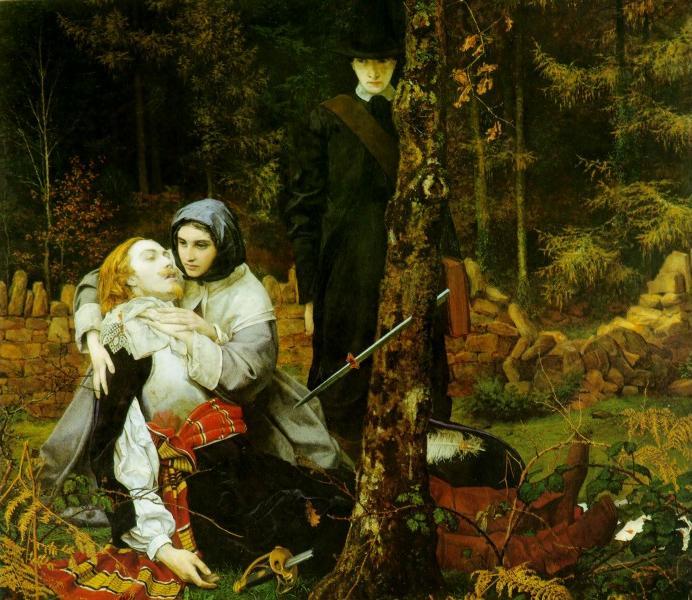
It has come to my attention recently that someone still in college has credited me with a quote regarding William Shakespeare Burton’s The Wounded Cavalier. That post of mine from 2008 no longer exists. The quoted passage doesn’t sound like me or anything I once wrote about the painting. I suspect what has happened is that the student followed a link in my post to someone else and then attributed that quote to me.

My writing students come to learn that any quote used in an essay needs to be introduced with a tag so that it is made clear who is speaking and where the quote appears. More importantly, the students come to learn that every source needs to be evaluated so that the audience can recognize what authority any one source carries. Sometimes the authority is obvious when the article appeared in say, The New York Times. What someone named firstcitybook says about a Pre-Raphaelite painting doesn’t carry any authority because my familiarity with the work has not been verified.

Whenever possible, I check my students’ sources, particularly when I have concerns about plagiarism and when the authority of a particular source is in question. Using quotation marks is a common problem among the college students that I encounter in my classes. Some students believe that providing in-text documentation eliminates the need for quotation marks; other students believe that providing the author’s last name at the end of a paragraph is sufficient even when all of the words borrowed from that source have not been enclosed in quotation marks. It doesn’t take TurnItIn, a software program that detects plagiarism, to discover these problems. Those students who tell me how much they hate to read and how little they have read encounter the most problems with quoting, documentation, and plagiarism.

The Puritan in The Wounded Cavalier can be described as an aloof male who doesn’t express sympathy for someone else. It’s possible that his political views prevent him from lending aid despite his religious faith regarding the wounded, the sick, and the poor. The student who credits me recognizes these things about the Puritan.

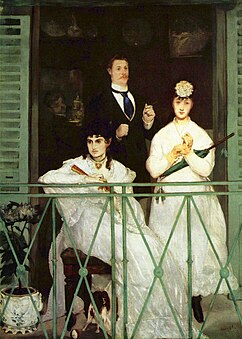
Probably one of the hardest essays I had to write in college as an undergraduate was an analysis of Edouard Manet’s The Balcony for a five-hundred-level art history class in French Impressionism. If I had not been writing essays about literature for the classes in my major field of study, I would have been overwhelmed. As I recall, I studied a dictionary of art terms and read the preceding chapters in my art history text before I started writing. The assignment didn’t require outside sources. I certainly would not have considered using a blog post if the Internet had been available at that time. I would have recognized, I hope, that a quote taken from a link would not have been attributed to the author of the blog who provided the link.

Saturday, December 29, 2012

Favorite Jazz Recordings for 2012


Before listing my favorite jazz albums for 2012, I have to make mention of two jazz albums that escaped my attention in 2011 and that would have made my list in 2011 if I had known about them.

I regret not having discovered Soren Dahl Jeppesen’s Red Sky until May, 2012 and not having learned about MBM Trio until October, 2012. Soren Dahl Jeppesen’s Red Sky can be found at Bandcamp. MBM Trio, featuring Lucia Martinez on drums, Antonio Bravo on guitar, and Baldo Martinez on bass, has a number of videos available at YouTube; their website can be accessed at this link.

My favorite jazz albums for 2012 appear below but in no particular order:

Yuri Honing’s Acoustic Quartet, True (Challenge Records)

Matthew Halsall, Fletcher Moss Park (Gondwana Records)

Scott McLemore, Remote Location (Sunny Sky Records)

Marc Johnson & Eliane Elias, Swept Away (ECM)

Espen Eriksen Trio, What Took You So Long (Rune Grammofon)

Bram Weijters-Chad McCullough Quartet, Urban Nightingale (Origin Records)

Brad Mehldau Trio, Ode (Nonesuch Records)

Martin Hoper, The Bride (Hoob Jazz)

Manu Katche, Manu Katche (ECM)

Partikel, Cohesion (Whirlwind Recordings)

Phronesis, Walking Dark (Edition Records)

Hans Glawischnig, Jahira (Sunnyside Records)

Links related to these recordings and musicians can be found to the right of this post in the What I'm Listening To gadget.

As the picture above reveals, I download the great majority of my music and burn it to CD so that I can hear this music in the car, on my alarm clock, in the kitchen on the portable stereo, and on the stereo I have set up in my home office. Once a year, for two years now, I have managed to win a free CD from All About Jazz. With my budget, I limit myself to one download per pay period and average two downloads a month from either Bandcamp or Amazon. Whatever I download is determined by what I have heard about the album from reading the online reviews, from following certain musicians on Twitter, from listening to videos on YouTube, and from hearing selected cuts on SoundCloud, where I follow certain musicians as well. Once in a great while, someone informs me of an album release through my e-mail.

It might be possible to characterize 2012 as a year in which many of the elder jazz musicians released either new material or material that was recorded live decades ago and not released until now. I chose not to explore those possibilities, partly because of my limited budget. I chose instead to pursue albums released by those contemporary musicians I have discovered in the past few years and by those musicians who have been new discoveries for me and whose work proves intriguing. There are many other young musicians whose work was released this year and whose work certainly deserves praise but isn’t represented in the above list. I will be on the lookout for those upcoming recordings by musicians who have only started to make their names known, some of whom I follow at SoundCloud.