Newspaper stories have been reporting on the number of cows that died in western Kansas and eastern Colorado as a result of the winter storm that struck at year’s end. The initial figure included 3,000 cows; revised figures, including the number of cows killed at feedlots, where grass fed cows are fattened with grains before slaughter (see Eric Schlosser's Fast Food Nation), now estimate that at least 15,000 cows have died.
This economic disaster for ranchers and feedlot owners reflects the problem of raising cattle unsuited for the climate on the Great Plains. Ranchers in the past have known similar problems during severe winters. These kinds of problems illustrate the lunacy of replacing the buffalo, a species that had adapted to the Great Plains over thousands of years, with the ill-suited beef cow. It’s true that the American government in the 19th century recognized that destroying the buffalo would effectively starve the Plains Indians and force them to rely on the government for handouts. That ethnocentric and ignorant view of the native people and that unwillingness to learn from, say, the Cheyenne, the Kiowa, and the Sioux regarding how to adapt to the Great Plains resulted in the economic problems that occurred because of severe blizzards and prolonged drought.
It’s doubtful that anyone in western Kansas and eastern Colorado will recognize the advantages of raising buffalo in place of cows. As Dan O’Brien describes in Buffalo for the Broken Heart, buffalo move aside the snow with their big heads so that they can get to the grass underneath. Frank and Deborah Popper were partially, if not totally, correct in calling for a Buffalo Commons, that is, an expanse of land in the Great Plains that has been restocked with buffalo. The Poppers recognized how suited the buffalo are to the climate of the Great Plains and understood the problems associated with using the underground aquifer to raise crops that are planted, fertilized, irrigated, and harvested using fossil fuels when both the water in the Ogallala aquifer and the fossil fuels are finite resources. Even if a large expanse of open land running from the Dakotas to Oklahoma weren’t set aside, the Poppers recognized the value of raising buffalo, the species most suited to the aridity and the temperature extremes found west of the 100th meridian. It’s true that less water is readily available now, compared to the 19th century when the Arkansas River, for example, actually contained more than a trickle of water. The amount of water required to supply buffalo would still be less than the amount currently used in agriculture. Raising buffalo would ultimately lead to hefty profits when the meat is packaged for retail at a place like Dillons or served at places like Ted’s Montana Grill in Kansas City. I haven’t yet begun to address the health benefits associated with eating buffalo instead of beef.
Thursday, January 11, 2007
Tuesday, January 09, 2007
Squaw Creek
Squaw Creek National Wildlife Reserve , a bird sanctuary located near Mound City, Missouri, which is north of St. Joseph and just a few miles off of I-29, reported recently that 203,000 snow geese are currently at the sanctuary, in addition to the 28,000 ducks, and 295 bald eagles. I manage to visit the sanctuary once every autumn. If I lived closer, I would welcome the opportunity to go there more often; it is about a two hour drive one-way from where I live. Spending time among the birds now, before the approach of a winter storm, would be preferable to preparing for another semester.
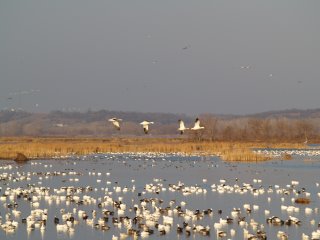
During my visit in November on what the merchants call Black Friday, that is, the day after Thanksgiving, there were more than 100,000 snow geese and about 200,000 ducks at the site. The weather that day was abnormally warm, about 55 degrees or so, and a number of frogs were sunning themselves along the pathway to the observation tower. The frogs would have made for an easy dinner for the great blue herons that typically layover before heading farther south.

The snow geese are more easily frightened than Canadian geese and some strange sound or an eagle passing close-by causes nearly the entire flock to suddenly lift off and circle the water where they had been resting just minutes before. All of this activity occurs as the geese are vocalizing to each other; the combination of what the Smithsonian Birds of North America refers to as “nasal barking” creates a cacophony that fills the afternoon and haunts one afterwards.
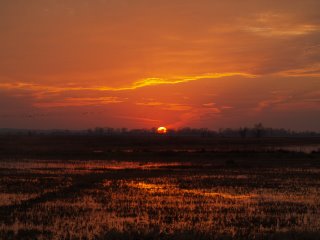
This nature reserve closes at dusk. A great many ducks return around this time from their forages for food in nearby fields. The combinations of their songs are especially pretty, with some birds more prominent at one moment but silent a moment later. Although I had been capturing the afternoon at this reserve with my camera, I was awestruck by the sounds that I was hearing and would have preferred remaining much longer. Those sounds are replayed in my head when I look at some of the pictures I took during that Friday afternoon.
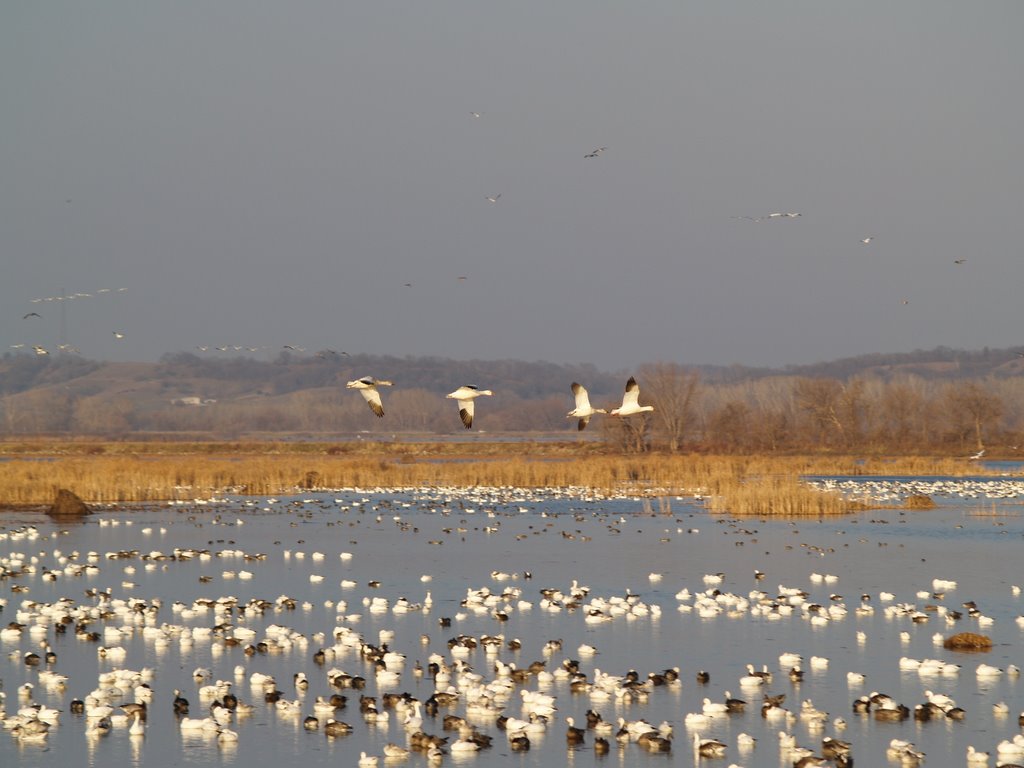
During my visit in November on what the merchants call Black Friday, that is, the day after Thanksgiving, there were more than 100,000 snow geese and about 200,000 ducks at the site. The weather that day was abnormally warm, about 55 degrees or so, and a number of frogs were sunning themselves along the pathway to the observation tower. The frogs would have made for an easy dinner for the great blue herons that typically layover before heading farther south.
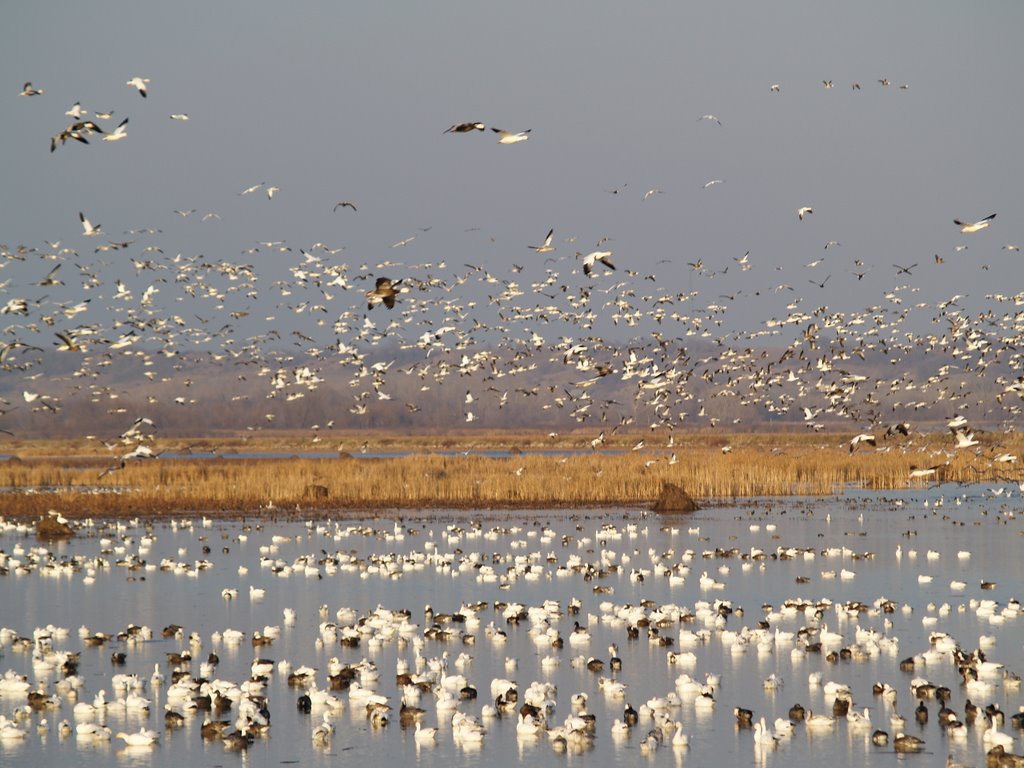
The snow geese are more easily frightened than Canadian geese and some strange sound or an eagle passing close-by causes nearly the entire flock to suddenly lift off and circle the water where they had been resting just minutes before. All of this activity occurs as the geese are vocalizing to each other; the combination of what the Smithsonian Birds of North America refers to as “nasal barking” creates a cacophony that fills the afternoon and haunts one afterwards.
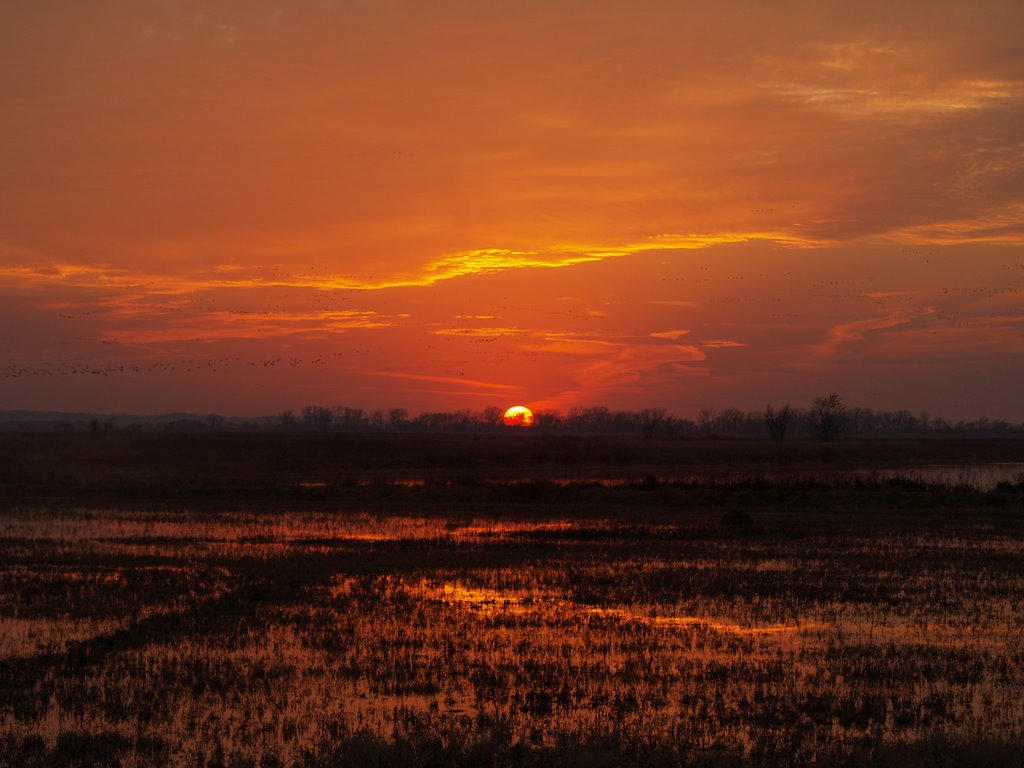
This nature reserve closes at dusk. A great many ducks return around this time from their forages for food in nearby fields. The combinations of their songs are especially pretty, with some birds more prominent at one moment but silent a moment later. Although I had been capturing the afternoon at this reserve with my camera, I was awestruck by the sounds that I was hearing and would have preferred remaining much longer. Those sounds are replayed in my head when I look at some of the pictures I took during that Friday afternoon.


Friday, January 05, 2007
A New Year Summary
It will be a year in February since I started this blog. I had loftier intentions at first by thinking that I would be addressing my job search and my current job situation, but I opted not to include that element of my life in detail, choosing instead to share my ennui with Ms. Mentor at the Chronicle of Higher Education. My postings initially either delved into Kansas history, particularly a writing and research assignment that my students had once engaged in, or pursued my interests in jazz, poetry, and Irish music. There occasionally have been postings in which I am more confessional about some of the details in my life, but those moments of disclosure are usually followed by the impersonal in the next several postings.
Through keeping this blog, I have learned the virtue of not describing the minutiae of my life. It’s doubtful that anyone really cares how often my poems are rejected or what happens on a daily basis in my life. Perhaps if I were commuting for almost two hours every day, as I once did before I began teaching online, I would find something to say about the idiocy of Kansas City drivers, the poor quality of the roads heading south into Johnson County, or the traffic jams that often tie up I-435, the freeway that loops around the Kansas City metro area.
My wife would say that males in general are less willing to disclose details of their private lives. I’m less taciturn now, but I’m not yet loquacious. There is no reason why I would want to describe the details of my marriage of twenty years or my previous relationships when I was single. Not much of a home repair type, I cannot describe my home improvement projects, apart from planting native flowers and grasses outside. I don’t even repair my car or my wife’s; we’ve actually been quite lucky with our vehicles and wouldn’t own anything but a Toyota.
The BBCNews recently reported that many of the blogs that have been created are generally abandoned within the first month or two because the blogger discovers how little he/she has to say after all. I’m certainly not as opinionated as Teacher Lady , the woman who provided the idea for this summary, but I have a few things to say every once in a while, mostly when I’m either trying to postpone grading a set of essays or when I’m not burdened with the demands of teaching five sections of writing, mostly composition.
Although I am less political than some other blogs, I am very much anti-war. This attitude surfaces at times. It generally doesn’t make much sense to rehash what others have said about current events, despite how maddening or how stupid certain events are in this country and elsewhere. Let it be said that the officials currently in office in Washington seldom reflect my views of government. I have to agree with Alice Walker who, after reading from her current book of essays and when answering questions on BookTV, says that there needs to be a major change in this county because capitalism neglects the majority of the people. When the economy collapses, and once the people come to recognize how government has not and will not meet their needs, some sort of major change will occur.
I confess that I want to spend whatever free time I have on writing essays and writing poems, but I still see myself maintaining this blog for a while longer. There are things I haven’t said yet about the Kidder Massacre and Beecher Island, for example. Who knows, maybe my own life will become a bit more exciting in the near future, not that I want to live in interesting times. Just a little excitement now and then could lead to a few more blog postings. Stay tuned for future developments.
Through keeping this blog, I have learned the virtue of not describing the minutiae of my life. It’s doubtful that anyone really cares how often my poems are rejected or what happens on a daily basis in my life. Perhaps if I were commuting for almost two hours every day, as I once did before I began teaching online, I would find something to say about the idiocy of Kansas City drivers, the poor quality of the roads heading south into Johnson County, or the traffic jams that often tie up I-435, the freeway that loops around the Kansas City metro area.
My wife would say that males in general are less willing to disclose details of their private lives. I’m less taciturn now, but I’m not yet loquacious. There is no reason why I would want to describe the details of my marriage of twenty years or my previous relationships when I was single. Not much of a home repair type, I cannot describe my home improvement projects, apart from planting native flowers and grasses outside. I don’t even repair my car or my wife’s; we’ve actually been quite lucky with our vehicles and wouldn’t own anything but a Toyota.
The BBCNews recently reported that many of the blogs that have been created are generally abandoned within the first month or two because the blogger discovers how little he/she has to say after all. I’m certainly not as opinionated as Teacher Lady , the woman who provided the idea for this summary, but I have a few things to say every once in a while, mostly when I’m either trying to postpone grading a set of essays or when I’m not burdened with the demands of teaching five sections of writing, mostly composition.
Although I am less political than some other blogs, I am very much anti-war. This attitude surfaces at times. It generally doesn’t make much sense to rehash what others have said about current events, despite how maddening or how stupid certain events are in this country and elsewhere. Let it be said that the officials currently in office in Washington seldom reflect my views of government. I have to agree with Alice Walker who, after reading from her current book of essays and when answering questions on BookTV, says that there needs to be a major change in this county because capitalism neglects the majority of the people. When the economy collapses, and once the people come to recognize how government has not and will not meet their needs, some sort of major change will occur.
I confess that I want to spend whatever free time I have on writing essays and writing poems, but I still see myself maintaining this blog for a while longer. There are things I haven’t said yet about the Kidder Massacre and Beecher Island, for example. Who knows, maybe my own life will become a bit more exciting in the near future, not that I want to live in interesting times. Just a little excitement now and then could lead to a few more blog postings. Stay tuned for future developments.
Thursday, January 04, 2007
Pawnee Rock
When I get the chance, I try to discover places that I haven’t yet gotten to know in Kansas. While visiting relatives in Pratt over the holidays, I managed to take a side trip to Pawnee Rock, which was a natural landmark along the Santa Fe Trail because it provided an overlook and gave the travelers an idea of where they were headed. Currently measuring 2,000 feet above sea level, Pawnee Rock was higher at one time, at least before the settlers began quarrying the rock for their houses.
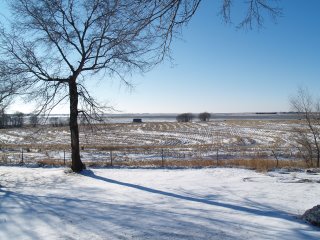
If the sky had been clearer (or if it had been less windy and less cold) during my visit, it would have been possible to see farther. According to Cheryl Unruh, whose website Flyover People first informed me of this place, it is possible to see Great Bend (twelve miles away), Larned (eight miles away), and a few other cities and towns from the structure built on top of Pawnee Rock. I want to return there sometime during the summer. It would be a great spot to picnic and to admire the scenery while basking in the sun.

Eventually, I have hopes of visiting Rock City, outside Minneapolis, the geographic center of the US outside of Lebanon, the Garden of Eden in Lucas, and hiking through the Flint Hills and the red hills of Barber County, in addition to revisiting Monument Rocks and discovering a few other places in western Kansas.
If there had been time enough, particularly if my twelve-year-old weren’t in a hurry to return to his video games, I would have liked stopping to take pictures between Peabody and Strong City on the way back from our holiday visit. What I need to do sometime is take a leisurely trip through the center of the state, beginning at Emporia.
At one time, I have hopes of taking my family on a cruise to Alaska, followed by a train ride across Canada, before we visit my sister in Connecticut. I also want my son to meet his Irish relatives and my wife to experience San Francisco, where I once lived, briefly, when younger. It is important, in the meantime, to know the place where one lives now because the exotic, the picturesque, if it cannot be found nearby, cannot be found anywhere.

If the sky had been clearer (or if it had been less windy and less cold) during my visit, it would have been possible to see farther. According to Cheryl Unruh, whose website Flyover People first informed me of this place, it is possible to see Great Bend (twelve miles away), Larned (eight miles away), and a few other cities and towns from the structure built on top of Pawnee Rock. I want to return there sometime during the summer. It would be a great spot to picnic and to admire the scenery while basking in the sun.

Eventually, I have hopes of visiting Rock City, outside Minneapolis, the geographic center of the US outside of Lebanon, the Garden of Eden in Lucas, and hiking through the Flint Hills and the red hills of Barber County, in addition to revisiting Monument Rocks and discovering a few other places in western Kansas.
If there had been time enough, particularly if my twelve-year-old weren’t in a hurry to return to his video games, I would have liked stopping to take pictures between Peabody and Strong City on the way back from our holiday visit. What I need to do sometime is take a leisurely trip through the center of the state, beginning at Emporia.
At one time, I have hopes of taking my family on a cruise to Alaska, followed by a train ride across Canada, before we visit my sister in Connecticut. I also want my son to meet his Irish relatives and my wife to experience San Francisco, where I once lived, briefly, when younger. It is important, in the meantime, to know the place where one lives now because the exotic, the picturesque, if it cannot be found nearby, cannot be found anywhere.
Subscribe to:
Posts (Atom)